
Sorting Procedures for Bulk Lab Created Ruby Loose Parcel
Receiving large commercial shipments of synthetic corundum requires systematic intake screening. For fine jewelry manufacturers, jewelry studio owners, and wholesale distributors, establishing a standardized sorting workflow eliminates costly mounting downtime and ensures seamless automated setting assembly. When receiving a fresh shipment of high-volume lab created ruby loose gems, sorting technicians must first establish a clean, color-neutral workstation using color-corrected daylight lamps rated between 5500K and 6500K.
The initial phase utilizes precision gemological sieves to divide the shipment into tight millimeter categories. Sizing tolerances in automated micro-pave casting lines must not exceed +/- 0.05 millimeters. Any dimensional drift beyond this tolerance causes setting failures, uneven prong alignment, or loose fits in high-end production lines.
Luminescence and Ultraviolet Emission Analysis
Ultraviolet evaluation serves as a rapid, non-destructive diagnostic step during bulk intake. Quality control teams often evaluate photoluminescence when assessing growth methods, raising the practical technical question of do lab created rubies fluoresce under standard shortwave and longwave inspection lamps. Synthetic rubies composed of aluminum oxide laced with chromium exhibit intense red fluorescence because laboratory growth environments strictly exclude iron.
Iron acts as an optical quencher in natural gems; its absence in cultivated corundum results in vivid photoluminescence. When operators verify whether do lab grown rubies glow under uv light with strong red emissions, they are witnessing the excitation of chromium ions uninhibited by iron impurities. Flame-fusion material typically displays extremely strong, uniform red glow under longwave UV (365nm), whereas flux-grown gems may show subtle variations based on flux chemistry. Detecting uniform luminescence across a parcel confirms consistent growth conditions and flags unintended glass or cubic zirconia contaminants immediately.
Optical Clarity and Internal Structure Sorting
Following dimensional and ultraviolet screening, gems undergo microscopic examination under 10x to 40x magnification using darkfield illumination. Technicians evaluate internal growth characteristics to separate commercial grades from top-tier stones. Flame-fusion stones require inspection for curved growth striae and microscopic gas bubbles, which indicate rapid crystallographic buildup. Hydrothermal and flux-grown stones present flux inclusions or chevron growth patterns that closely mimic high-grade natural corundum.
Color sorting requires establishing master stones to categorize parcels into distinct color bands: classic pigeon-blood red, vivid pinkish-red, and deep burgundy. Sorting technicians isolate pieces with uneven color distribution or heavy zoning to maintain batch consistency for mass-market ring production and studio custom settings.
Cutting Symmetry, Table Proportions, and Polish Grading
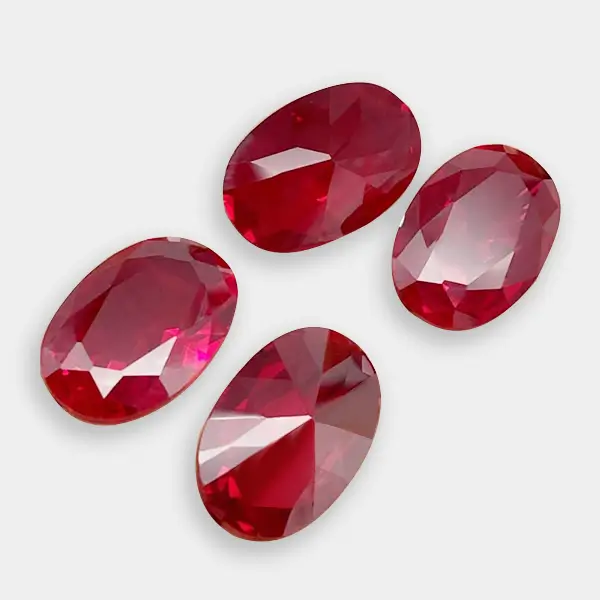
The final sorting stage focuses on optical performance and mechanical symmetry. Table percentages, crown angles, pavilion depths, and girdle thickness must be measured against strict production specifications. Asymmetric facets or off-center culets compromise light return, resulting in dead spots or windowing where light leaks through the pavilion rather than reflecting back to the observer.
Technicians visually inspect facet junctions under polarized light to identify stress strains or polishing chatter marks. Only gems exhibiting brilliant polish, sharp facet junctions, and optimal light dispersion pass to final packaging. Implementing this multi-tiered sorting procedure protects manufacturing yields, optimizes setting turnaround times, and maintains brand reputation across global distribution channels.